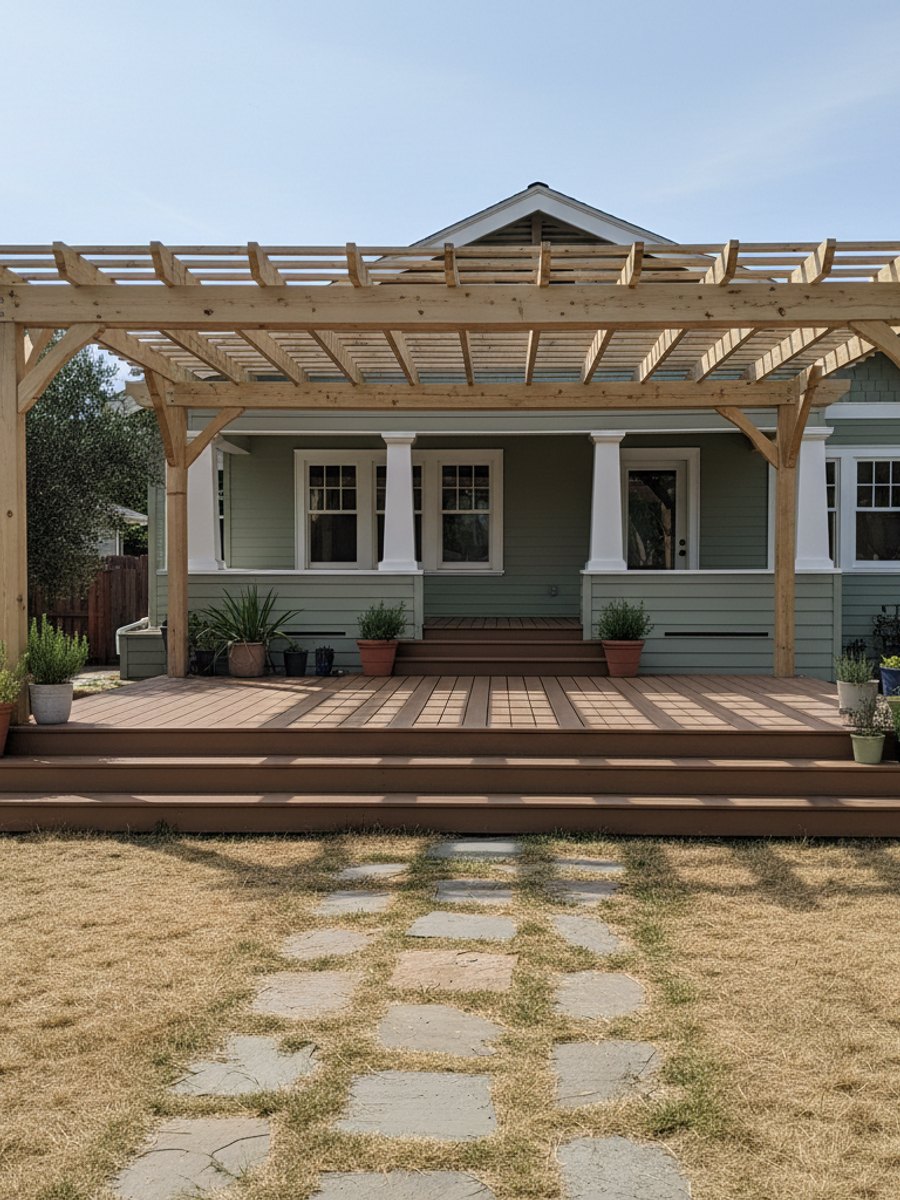
Fresno gets more deck quotes wrong than most cities its size, mostly because the soil here doesn't behave the way people assume it does. Before you sign anything, it helps to know what a builder should already know cold.
What the ground does to a Fresno deck
Most of the valley floor around Fresno sits on adobe clay, the kind that swells when it's wet and shrinks hard when it dries out. A deck footing poured in March, when the ground is saturated from winter rain, can sit in soil that's a different volume by August. That movement is what cracks concrete piers, tilts posts, and works fasteners loose at the ledger board over a few seasons. A builder who's worked here knows to set footings deep enough to get past the active zone, usually 18 to 24 inches depending on the site, not just the 12-inch minimum you'd get away with in sandier ground. If a contractor tells you footing depth doesn't matter much, that's someone who hasn't dug a post hole in Fig Garden or Tower District clay in July and hit something closer to brick than dirt.
Older neighborhoods, Tower District, the Fig Garden area, parts of Sunnyside, were mostly built from the 1940s through the 60s and often have original concrete footings that were never engineered for a deck load at all, just a porch stoop. If you're adding a deck onto a house that age, expect the builder to want to inspect or replace what's already there rather than build on top of it. Newer subdivisions out toward Clovis and Sanger are usually sitting on compacted fill, which drains differently and can settle unevenly near the edges of the lot if it wasn't compacted well to begin with.
Permits, HOAs, and what actually gets inspected
Inside Fresno city limits, deck permits go through the City of Fresno Building and Safety division. Clovis has its own building department and its own process, separate from the city of Fresno. If you're outside both, in unincorporated county land, Fresno County handles it. Any deck attached to the house and elevated more than about 30 inches above grade generally needs a permit, and the inspector will be looking at footing depth, ledger board attachment to the house framing, joist spacing, and guardrail height, which California code sets at 36 inches minimum for most residential decks and 42 in some jurisdictions for certain configurations. A contractor who says permits are optional, or offers to skip one to save time, is putting your homeowner's insurance at risk if anything ever happens on that deck. Newer subdivisions in northeast Fresno and much of Clovis also have HOAs, and some have design guidelines on railing style, decking color, or even whether composite is allowed at all. Ask upfront whether your neighborhood has one, because a builder should be asking you that before they draw anything.
Materials and what the Central Valley heat does to them
Fresno summers run 100 degrees or hotter for weeks at a stretch, usually July through September, and that changes how certain materials get installed. Composite decking expands and contracts more than wood with temperature swings, so boards need gaps left between them at install, typically an eighth of an inch or so depending on the manufacturer's spec, or you'll get buckling by the following summer. Stain and sealer on a wood deck need the right window too. Applying sealer when the deck surface is over about 90 degrees means it can flash-dry on top before it soaks in, which looks fine for a season and then peels. A builder who works here regularly should be scheduling staining jobs for early morning, or shifting them to spring or fall rather than mid-August. Redwood and cedar are common choices locally and both do fine in this climate, but pressure-treated pine needs to be fully dried out before staining or the finish won't hold.
The contract and the license, not just the quote
Any deck builder working in California needs a CSLB license, and for structural work like framing or footings, that license needs to be current, not expired or borrowed from a relative's business. Ask for the license number and look it up yourself on the CSLB website, it takes two minutes. California law also caps the deposit a home improvement contractor can ask for upfront at 10 percent of the job cost or $1,000, whichever is less. A contractor asking for half the money before they've started, or all of it in cash with no invoice, is not following that law, and that alone should end the conversation. A real contract should spell out the framing lumber grade or composite brand and line, footing depth, railing height, and a rough timeline, not just a total price. If the quote is a single number on a napkin with no material specs, you don't actually know what you're buying.
Questions worth asking before you sign
- Will you pull a permit, and will the city or Clovis inspector sign off before boards go down?
- How deep are the footings going, and why that depth for this lot?
- What's the gap spacing on the decking, and does that change by material?
- Can I see photos of a deck you built here at least two years ago, not last month?
- What's your plan if the framing under an existing deck turns out rotted once you open it up?
That last one matters more than people expect. On repair jobs especially, a builder can't always know what's underneath old decking until it's pulled up, and a contractor who guarantees a fixed price sight unseen on a repair is either padding the number heavily or planning to cut corners once they find something they didn't quote for.
We've built and repaired decks across Fresno and the surrounding towns long enough to know which streets have clay that fights you and which subdivisions have fill you can trust. If you want a second opinion on a quote you've already got, or want to start from scratch, take a look at our deck builder work and reach out.